
Igwe Josiah Nnaji Orizu II
Igwe Josiah Nnaji Orizu II (1901–1962) was the 19th Obi of Otolo and Igwe of Nnewi Kingdom, reigning from 1924 until his death in 1962. He succeeded his father, Igwe Orizu I (Eze Ugbonyamba), and became one of the most influential traditional rulers in the history of Nnewi.
His reign was marked by remarkable social reforms, educational advancement, healthcare development, road construction, and the modernization of Nnewi society. He was also the first Igwe of Nnewi to openly embrace Christianity while remaining the custodian of the sacred Ofo Nnewi and the traditional institutions of the kingdom.
He was the brother of Prince Abyssinia Nwafor Orizu, President of the Nigerian Senate and Acting President of Nigeria, and the father of Igwe Kenneth Onyeneke Orizu III, the current traditional ruler of Nnewi.
Early Life and Education
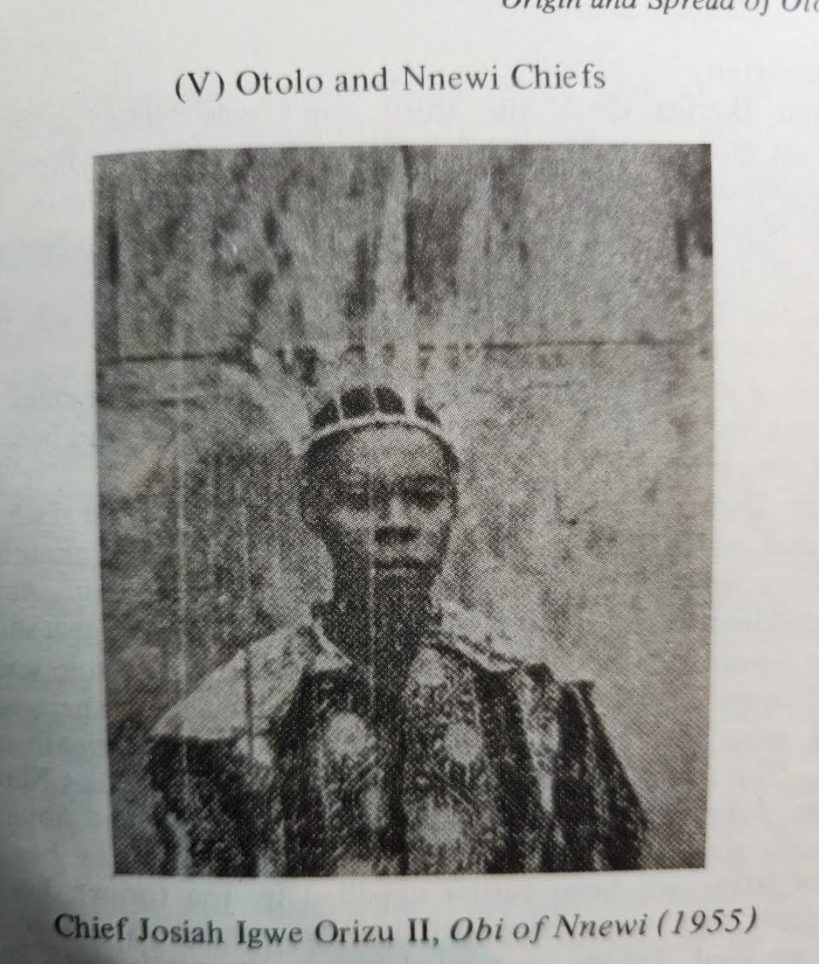
Igwe Josiah Nnaji Orizu II was born in 1901 into the royal House of Nnofo, the ruling dynasty of Nnewi Kingdom.
He enjoyed a strong Christian and missionary upbringing and spent part of his youth as a ward of the renowned Reverend Ibeneme of Obosi.
His early education began at Primary School Arondizuogu, after which he proceeded to CMS Central School, Nkwo Nnewi. He later gained admission into the prestigious Hope Waddell Training Institute, Calabar, one of the foremost educational institutions in colonial Nigeria.
His studies were interrupted in 1924 following the death of his father, Igwe Orizu I (Eze Ugbonyamba), when he was recalled home to assume the throne of his ancestors.
He was enthroned that same year as the 19th Igwe of Nnewi Kingdom.
Ascension to the Throne
Following the death of Igwe Orizu I in 1924, Josiah Nnaji Orizu inherited the sacred Ofo Nnewi, the symbol of traditional authority and spiritual leadership in the kingdom.
Although still a relatively young man, he quickly established himself as a progressive and visionary ruler committed to the advancement of Nnewi people.
His reign coincided with a period of increasing colonial influence, educational expansion, and political transformation across Eastern Nigeria.
First Christian Igwe of Nnewi
Igwe Josiah Orizu II occupies a unique place in Nnewi history as the first traditional ruler of Nnewi to openly embrace Christianity.
Despite his Christian faith, he remained deeply committed to preserving Nnewi customs, traditions, and indigenous institutions.
As holder of the Ofo Nnewi, he continued to serve as the spiritual custodian of the kingdom while demonstrating that Christianity and traditional leadership could coexist.
His reign therefore represented an important bridge between traditional Nnewi society and the emerging Christian era.
Community Development and Modernization
One of the defining features of Igwe Orizu II’s reign was his commitment to community development.
He initiated an ambitious programme aimed at improving the welfare and living standards of the people of Nnewi.
Among his notable achievements was the establishment of a Palace Dispensary, where medical treatment was provided free of charge to residents.
He successfully attracted several important government institutions to Nnewi, including:
- The Local Authority Treasury
- The Nnewi Postal Agency
- The Modern Post Office established in 1951
Working closely with the Nnewi Patriotic Association, he introduced numerous social reforms that transformed community life.
Recognition of Twins and Healthcare Reforms
Under his leadership, Nnewi witnessed significant social reforms.
One of the most important was the formal recognition and acceptance of twins, ending discriminatory practices that had existed in some communities.
He also supported the establishment of:
- Leprosy treatment centres
- Yaws treatment clinics
- Community healthcare facilities
Particularly notable was the development of medical facilities along the Nnewi–Amichi axis, improving access to healthcare for thousands of residents.
The Native Authority Dispensary at Eme also received full recognition from the British Colonial Administration during his reign.
Establishment of Afia-Olu (New Yam Festival)
Igwe Josiah Orizu II played a pivotal role in standardizing and preserving Nnewi cultural traditions.
One of his most enduring achievements was the introduction of a unified New Yam Festival for Nnewi.
In 1932, he established the first kingdom-wide celebration known as Afia-Olu.
Before then, only Uruagu celebrated the New Yam Festival independently.
The establishment of Afia-Olu strengthened cultural unity among the four quarters of Nnewi and remains one of the most important annual festivals in the kingdom today.
Road Construction and Infrastructure Development
With the cooperation of the Obi of the other three quarters of Nnewi, Igwe Orizu II championed the construction of major roads linking the communities of the kingdom.
These projects significantly improved transportation, trade, communication, and access between the various quarters of Nnewi.
The road network laid the foundation for the rapid commercial growth that Nnewi would later experience.
Educational Advancement
Education received unprecedented attention during his reign.
Under his leadership, Nnewi witnessed the establishment of:
- Twenty primary schools
- Two teacher-training colleges
- Three secondary schools
These institutions produced generations of educated Nnewi men and women who later distinguished themselves in business, government, academia, religion, and public service.
His commitment to education remains one of the most celebrated aspects of his legacy.
Political Leadership and Eastern House of Chiefs
Igwe Orizu II was not only a traditional ruler but also an influential political leader.
He served for several years as President of the Nnewi District (Agbaja) Customary Court, where he was respected for his wisdom and fairness.
He was also a traditional member of the Onitsha Southern County Council.
In 1952, he became the first President-General of the Eastern Chiefs Conference, which was founded in his palace at Nnewi.
His stature continued to rise throughout Eastern Nigeria, leading to his election into the Eastern House of Chiefs in 1959, on the eve of Nigeria’s independence.
In 1960, he became a foundation member of the Eastern House of Chiefs, helping shape traditional leadership in the newly independent nation.
Family Life
Igwe Josiah Nnaji Orizu II maintained a large royal household in keeping with the customs of his era.
At the time of his death in 1962, he was survived by:
- 15 wives
- 61 sons
- 72 daughters
- 107 grandchildren
His descendants continue to occupy important positions within Nnewi society and beyond.
Among his children was Igwe Kenneth Onyeneke Orizu III, who succeeded him on the throne and remains one of the longest-serving traditional rulers in Nigeria.
Death and Legacy
Igwe Josiah Nnaji Orizu II died in 1962 after thirty-eight years on the throne.
He left behind a transformed kingdom characterized by educational advancement, healthcare development, improved infrastructure, cultural preservation, and political influence.
Today, he is remembered as:
- The first Christian Igwe of Nnewi.
- The founder of the modern Afia-Olu Festival.
- A champion of education and healthcare.
- A progressive traditional ruler and reformer.
- A founding leader of the Eastern House of Chiefs.
- The father of Igwe Kenneth Onyeneke Orizu III.
His reign remains one of the most productive and transformative periods in the history of the Nnewi Kingdom.
Views: 134